The Kitchen · 8 min read
Journal · The Kitchen
THE ROAST CHICKEN
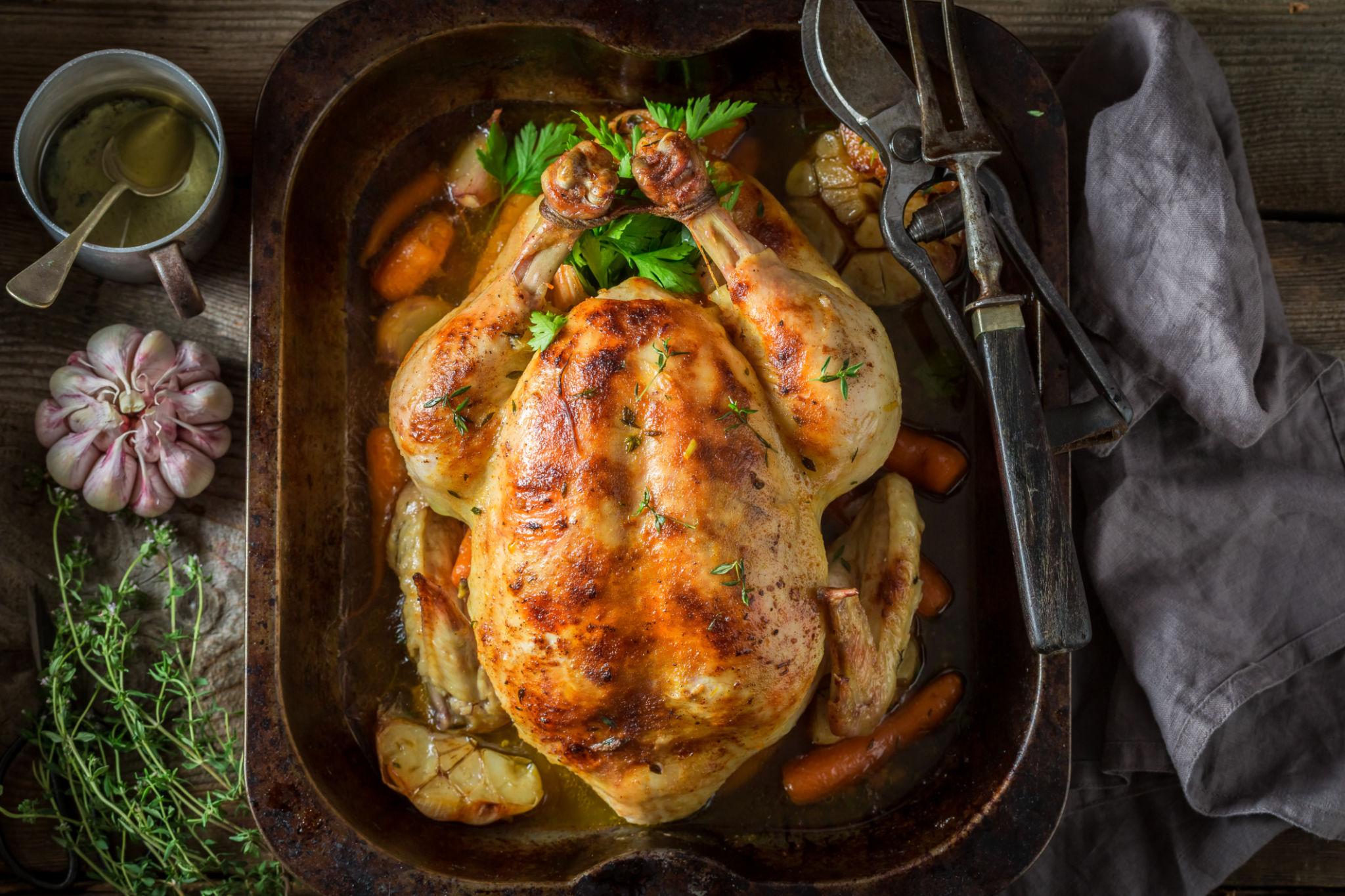
The Roast Chicken
There is probably no dish more exposing in a restaurant than roast chicken.
People forgive complexity when it misses slightly. They forgive ambition. But roast chicken is different. Everyone has an internal reference point for it — something remembered from childhood, or Sunday afternoons, or a tiny bistro somewhere they still talk about years later. Which means when you put roast chicken on a menu, you're entering an argument whether you mean to or not.
We've been cooking ours the same way for nearly six years now.
The Birds
The chickens come from a small farm in the Loire Valley, though during winter shortages we occasionally source closer to home. Slow-grown birds only. Yellow-skinned, properly exercised, around one-point-eight kilos each.
The difference is visible before you even cook them. Firmer flesh. Darker legs. Fat that actually tastes of something.
Fast-grown chicken has its uses, perhaps. Roasting isn't one of them.
People often assume tenderness is the main goal with chicken. It isn't. Texture matters, but flavour matters more. We'd rather serve a bird with slight resistance in the leg meat than one that collapses into softness without tasting of anything at all.
The Drying
The birds arrive on Wednesday morning and are salted immediately — generously, inside and out — then left uncovered on racks in the walk-in fridge for up to forty-eight hours.
This step alone changed the dish more than almost anything else we've done.
The salt penetrates the meat slowly and seasons it evenly, but more importantly the skin dries out completely. Moisture is the enemy of crispness. Good roast chicken skin should shatter slightly under the knife.
There is no shortcut for this part. Air needs time to do its work.
The Roasting
We roast the chickens in cast-iron pans rather than trays. A small detail, but an important one. The iron holds heat aggressively and colours the underside properly instead of steaming it.
Into the cavity goes half a lemon, garlic, thyme, and sometimes a little stale bread to absorb juices from within. The birds are brushed with brown butter and roasted initially at 220°C to set the skin, before dropping to 175°C for the remainder of the cook.
Every fifteen minutes they are basted.
Not delicately. Properly.
Chicken responds to attention more than almost any other meat. Leave it alone entirely and it dries. Handle it too much and the skin softens. There is a narrow middle ground where things become excellent.
The Smell
This is impossible to write about properly, but worth mentioning anyway.
There is a moment around forty minutes into roasting where the kitchen smells overwhelmingly of thyme, hot fat, garlic, and caramelising chicken skin. Service staff mysteriously find reasons to walk through the kitchen at this point.
The Sauce
The roasting pans are never washed directly after service. All the caramelised residue — the sticky mixture of butter, stock, chicken fat, and concentrated juices — forms the base of the sauce.
Shallots go in first. Then white wine. Then chicken stock reduced separately over the course of the afternoon.
The final sauce should taste intensely of roast chicken rather than cream or wine or herbs. We mount it lightly with butter right at the end and sharpen it with a few drops of cider vinegar.
People often ask if there's cream in it.
There isn't.
The Bread Sauce
This is the part visitors from outside Britain tend to question until they try it.
Milk infused with onion, clove, bay, and black pepper. Fresh breadcrumbs folded in slowly until the consistency sits somewhere between sauce and custard. Finished with butter and nutmeg.
Comforting in the best possible way.
A Few Things We've Learned
— Dry skin equals crisp skin. Nearly every roast chicken problem begins with moisture.
— Rest longer than feels sensible. At least thirty minutes before carving.
— Baste more frequently toward the end of cooking, not the beginning.
— Good chicken leaves enough flavour in the pan to build an entire second dish from the drippings alone.
The Last Plate of the Night
The final roast chicken of service is usually the one kitchen staff split among themselves after close. Slightly over-reduced sauce. A few burnt edges. Extra salt because nobody's watching.
Almost always eaten standing up.
Which, honestly, is perhaps the best test of whether a dish belongs on a menu or not. If the people cooking it still want to eat it after years of repetition, you're probably doing something right.
— M.T.
Short rib
Braising
The Kitchen
Recipes
Share
@
tw
ig
Continue reading
More from the Journal
Suppliers · 01 Apr 2026
THE ROAST CHICKEN
At four in the morning the harbour is quiet, except for eight men we know by name.

Suppliers · 01 Apr 2026
The Onion Soup
At four in the morning the harbour is quiet, except for eight men we know by name.

Suppliers · 01 Apr 2026
Why our short rib takes thirty-six hours
At four in the morning the harbour is quiet, except for eight men we know by name.